

Dissociation Nation.
Brand and the architecture of avoidance.

Root touch-up, highlights, cut, blow-dry, style.
An act of consumption that barely registers as such, so ingrained is it into our cultural expectations for women ‘of a certain age’ (until we’re allowed to give up at some point, once all desirability fades). The unquestioned routine of millions of us around the world.
Don’t get me wrong, I enjoy those 3 hours in the salon chair. Outside of the significant financial outlay, the experience is hardly punishment; a treat, even.
Chatting about nothing. Catching up with emails. Staring into space. The promise that I am almost certainly walking out looking better than when I walked in.
So I happily sit there in my hairdresser bubble, that pampered cocoon, checked-out of the reality beyond the door. And then I read this in my inbox:
Freedom cannot arise while avoidance remains...
This includes avoidance around sex, money and power that exist in all of us.
Actual freedom requires emotional sovereignty, structural overhaul, and a reconnection to truth. It’s an identity shift where addiction and extraction and exploitation must be acknowledged and integrated.
It requires us look at where we have dissociated to the point of not being able to feel our own emotions or the impact of our actions.
To look at the denial that protects us from heartbreak and the avoidance that shields us from responsibility.
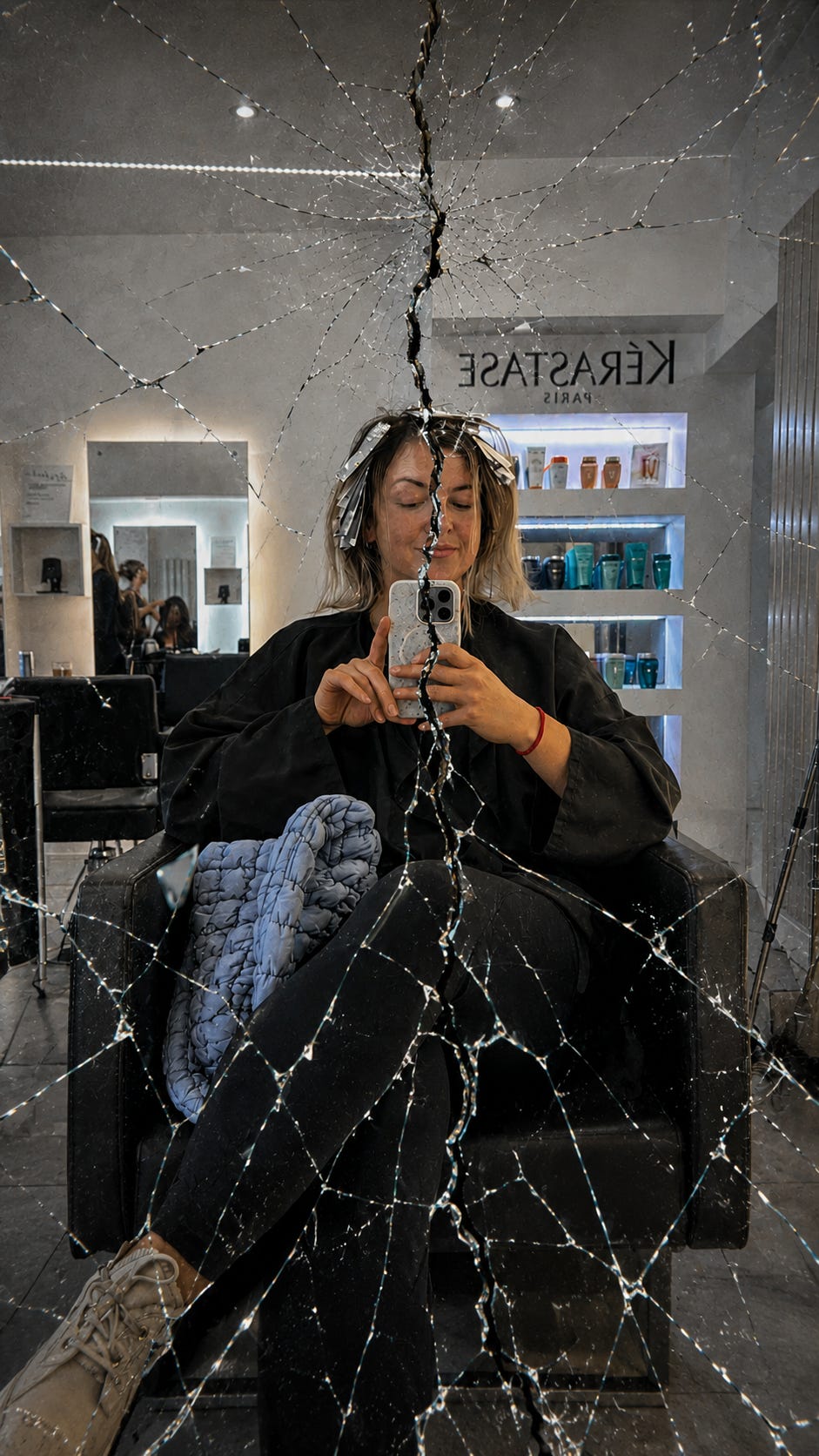
Dissociation is the act of disconnecting or the state of being disconnected. It exists on a spectrum: from everyday experiences like zoning out while driving to more severe symptoms associated with trauma.
It is a separation of mind from body, from the present and from your immediate environment. A built-in escape hatch, a neurobiological Hail Mary, for when our system cannot cope with what it is being asked to experience.
To be human, at its most fundamental level, is to have an unmediated connection to the purest experience of ourselves. When we are disconnected from our true selves and emotions, we are plagued with a trauma that kills us from the inside out.
So what does it signify to be humans living in a society architected to facilitate that experience, with greater and greater efficiency? Where that experience is becoming more compelling than the reality on offer? When we are actively seeking out such a state — or when we are unable to avoid it?
This is what brands have become: architects of dissociation.
Advertising and marketing, branded experiences: the architecture of avoidance.
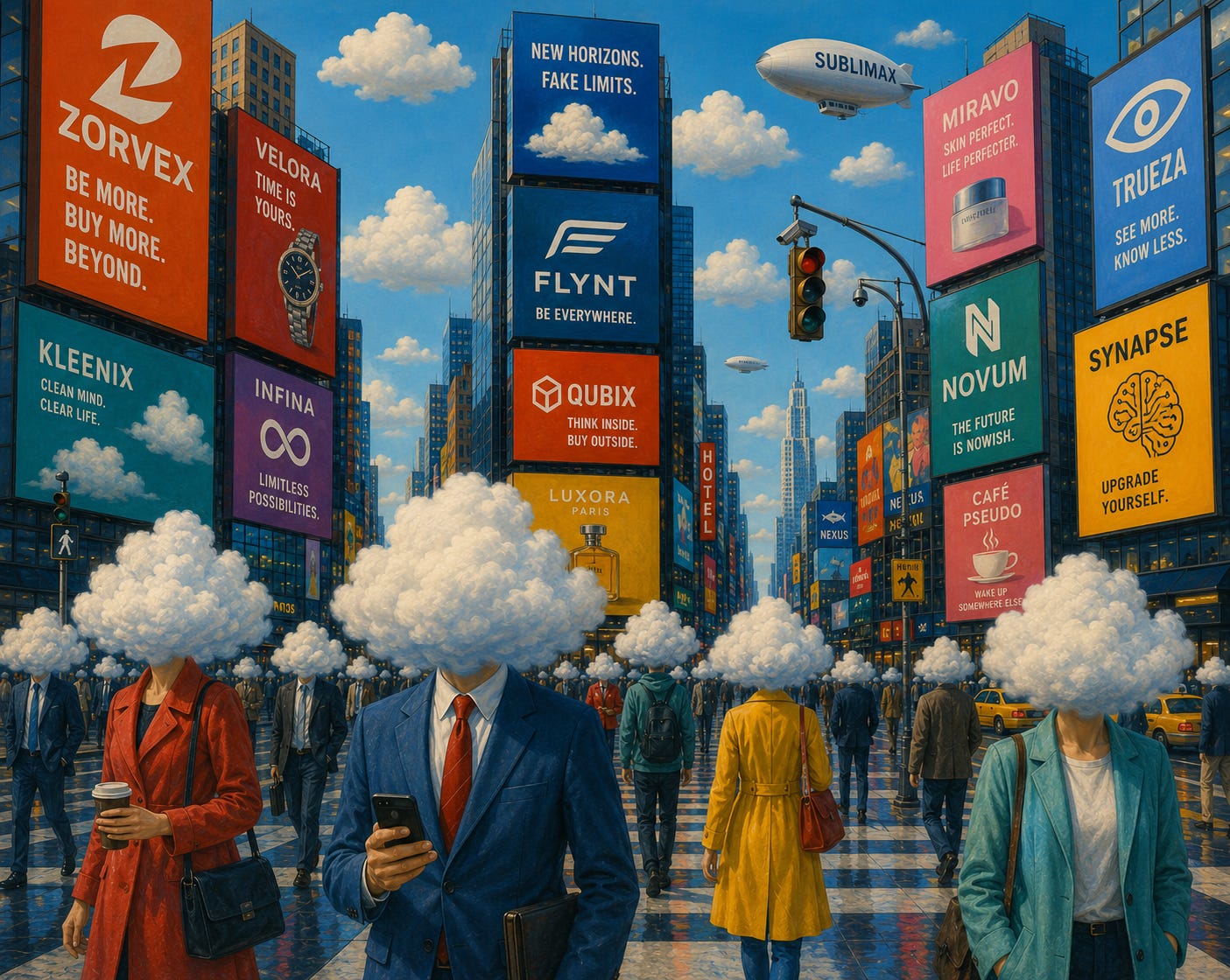
Brands exist to build trust with a target consumer — and to obscure the politics of their existence. They are obfuscation as much as they are ‘choice navigation’. The smiling happy face plastered on the faceless corporation.
The brand engine: fantasy. The aim: to signpost away from reality to the new and improved future they’re promising.
Every advertisement, every marketing message, every alluring invitation to be anywhere but where you are right now. You should be in this restaurant. You should be seeing this film. You should be driving this car. You should be this better-dressed, fitter, slimmer, tighter, smoother, more emotionally stable, more intelligent, more successful version of yourself.
The products and services themselves are almost irrelevant. The act of consumption and the experience built around the act is the point. These moments live brief lives, often a simulacrum of the promised fantasy. The sensory memory fades. The food is digested. The decorations trashed. The clothes stripped off. The make-up washed away.
Social media offers consumers way to preserve these moments, a game where users compete to contrive the most perfect, most aesthetically compelling version of the brand fantasy. But there is no finish line, no grand final, no podium. The brand-sponsored performance of fantasy never ends.
The consumption is memorialised in the feed. Another technicolour tombstone added to the collection. And just a scroll away is the seed of the next one…

When this separation from reality is deliberately designed and engineered, the act goes beyond separation to severance. When those moments of severance are infiltrating our lives with alarming speed, with insidious efficacy, and without our consent, it is imperative we wake up to the architecture of our attention and ask ourselves:
What reality is this taking me away from? What am I avoiding? What am I numbing?
While we are scrolling, our rights are being eroded. Our empathy sandpapered to nothing. Our data sold to the highest bidder. Our public spaces and infrastructure, such that remains, sold off and privatised piece by piece. Our ecosystem ravaged. Our climate simmering to a boil. Our choices reduced to this colour way, or that colour way. The number of futures in which we have genuine agency whittled away.
And why wouldn’t we avoid this? These problems are difficult. Complex. So complex. Insurmountable. Nigh-unsolvable — or at least that’s what we’re told. That’s what we have come to believe. And why is that?
“Because our economy is every bit as fragile as the environment.”
Words spoken by the U.S. Vice President in 2004’s The Day After Tomorrow, the cardboard villain who in his refusal to accept the overwhelming evidence of imminent catastrophe, condemned everyone above the Mason-Dixon Line to death (not to mention Canada, who I suppose were always going to be screwed in that scenario). Twenty years since its release and we’ve accepted his position as the status quo.
We need to wake up, collectively.
Those of us working in brand, especially, need to be aware of what we are facilitating, what we are complicit in: Are we offering a way out? Or a way in?
Jasmine Bina again points us in the right direction:
But the future belongs to the frameworks that fuse science and soul, logic and sensation, intellect and instinct. The body doesn’t want to be hacked. It wants to be understood. People want to feel whole.
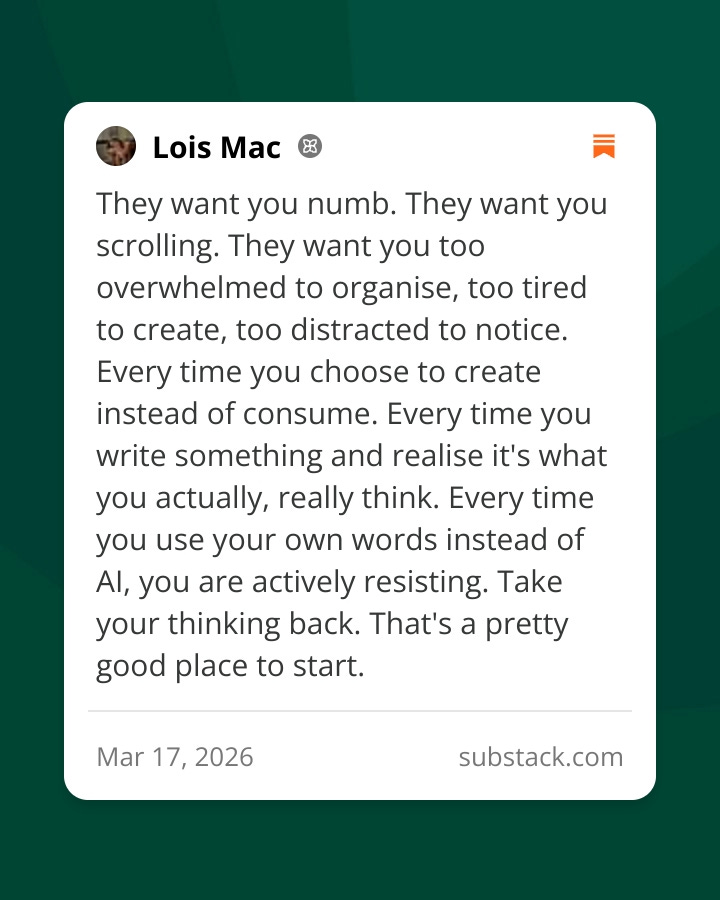
And Lois Mac has the place to start:
I wrote this piece in between spurts of online shopping for an upcoming work event. Every few paragraphs, like magic, another potential piece to build an outfit around popped into my consciousness unprompted.
What about a sleeveless blazer? How about a dress? What type of dress? It might be hot, have you considered a linen pant? And then you’ll need shoes…
Every new item of clothing required an immediate search; one scroll became two, three, four, click, click, click, filter, size, colour, price, save for later, add to cart — wait what was I doing?
I was only partly here, engaged in writing. The rest of me was considering my outfit equation with the studied intensity of a mathematician attacking the Riemann Hypothesis.
Obsessively hunting for the perfect pair of heeled loafers seemed urgently important. Far more important than finishing this post that had been sitting in my drafts folder for 3 months.
I still don’t know what I’m wearing.
I’m Mimi Hayton: a strategist, editor, writer and systems thinker.
Marque is a newsletter examining the architecture of culture — the constructed systems, narratives, and environments that we live inside of — through the lenses of brand and ethics.
Marquess Studio is my creative agency specialising in brand strategy, transformation and storytelling.
Unlocked is my bespoke personal brand and thought leadership offering for those ready to unlock the value of their unique insights and become known for how they think.
This reminds me, of I think a "farside"comic showing a man sitting in a house watching the sunset on TV and through the window was the real sunset !! But he choose a mediated version ...its older technology but probably where the dissociating began !
This is why we work to bridge the gap between the brands we work with and culture and community. It's so important for us to push what people actually care about, and elevate them with brands that align.